Critical Illness
Critical Illness Insurance in Atlantic Canada: The Complete Guide to Tax-Free Coverage
If you've searched "critical illness insurance" or "what does critical illness insurance actually cover," you've probably noticed most explanations either oversimplify it or bury it in fine print. Critical illness insurance is one of the least understood types of coverage available to Atlantic Canadians, even though it can matter as much as life insurance itself.
This guide covers what critical illness insurance actually is, what it pays for, how it's different from life insurance and disability insurance, and why comparing providers matters more with this type of coverage than with almost any other.
What Is Critical Illness Insurance?
Critical illness insurance pays you a tax-free lump sum if you're diagnosed with a covered serious illness, such as cancer, a heart attack, or a stroke. Unlike life insurance, the payout arrives while you're alive, when you and your family are actually dealing with the diagnosis, not after.
There's no restriction on how the money is spent. Some people use it to cover the mortgage while they're off work. Others use it for treatment costs, travel for care, or simply to keep the household running without dipping into savings or going into debt.
What Critical Illness Insurance Actually Covers
Nearly every policy in Canada is built around what's often called "the big three": cancer, heart attack, and stroke. These three conditions account for the large majority of critical illness claims, and they're covered on virtually every policy available, regardless of provider.
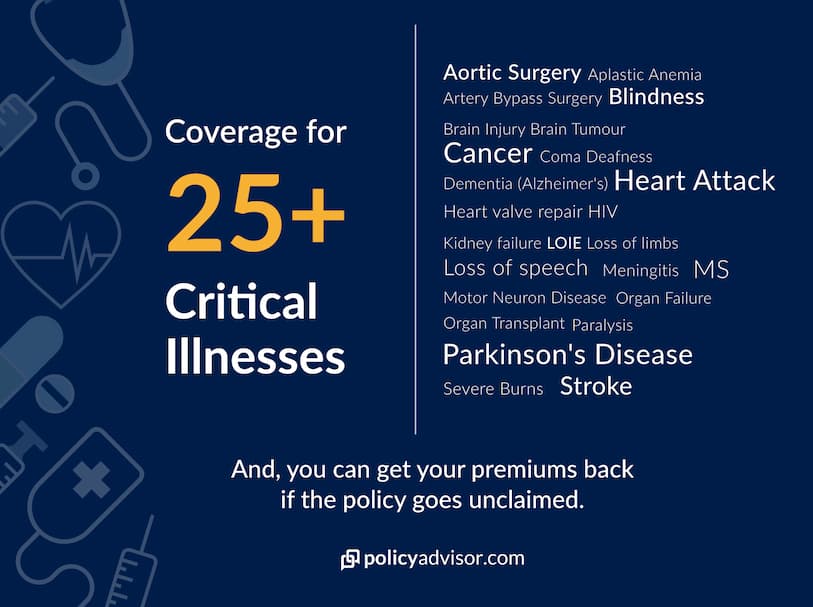
Beyond the big three, coverage varies significantly by provider and product. Some policies cover a defined, more focused list of conditions. Others extend to 25 or more, including things like kidney failure, paralysis, major organ transplant, and Parkinson's disease. A few products also include partial payouts for early-stage or less advanced conditions, so a policy can respond even before an illness reaches its most serious stage.
Coverage amounts also vary widely, from a few thousand dollars for narrower, simplified products up to several million dollars on more comprehensive policies. There's no single "right" amount. It depends on what a serious diagnosis would actually cost your household: lost income, treatment, travel, and the debt or mortgage payments that don't pause just because you're sick.
One detail worth understanding upfront is the survival period: the length of time you need to survive after diagnosis before a claim pays out. For the big three, this is typically 30 days. Some conditions carry a longer survival period depending on the provider and the specific illness. It's standard across the industry, not something unique to any one company.
How It's Different From Life Insurance and Disability Insurance
These three types of coverage get confused constantly, and the distinction matters:
Life insurance pays a benefit to the people you leave behind, after you die. Critical illness insurance pays you directly, while you're alive, on diagnosis of a covered condition. Disability insurance is different again: instead of a single lump sum, it replaces a portion of your income with ongoing monthly payments while you're unable to work.
Many families benefit from more than one of these, because they solve different problems at different moments. It's also worth checking what your workplace group benefits actually include. Group critical illness coverage, when it exists at all, is often modest relative to what a real diagnosis costs, and it typically doesn't travel with you if you change jobs or retire.
Access to Every Major Canadian Provider, Compared for You
This is where critical illness insurance differs from some other types of coverage: it's offered by nearly every major insurer in Canada, and the products vary more between companies than most people expect. Condition lists, pricing, survival periods, partial payout features, and return-of-premium options can all look meaningfully different from one provider to the next.
That makes the choice of advisor as important as the choice of insurer. Working with an advisor who is licensed to place coverage across the market, rather than one tied to a single company's product, means you get a genuine comparison instead of a single quote. Mike Plume is licensed to place critical illness coverage through Canada's major insurers, including Assumption Life, Canada Life, Empire Life, Manulife, Sun Life, iA Financial Group, Equitable Life, Wawanesa Life, and Foresters Financial, so the recommendation is based on what actually fits your health and budget, not on which single company an advisor happens to represent.
Working With a Local Advisor
Setting up critical illness coverage involves real decisions: how much coverage, which conditions matter most for your situation, whether a return-of-premium or partial payout feature is worth the added cost, and which provider offers the best combination of those features for your age and health.
Mike Plume is a licensed financial advisor based in Fredericton, NB, serving clients across New Brunswick, Nova Scotia, and PEI, with 15 years of experience helping Atlantic Canadian families and individuals plan for the unexpected. You get a direct line to the same advisor who set up your policy, not a new support ticket every time your situation changes.
Frequently Asked Questions
Is the payout from critical illness insurance really tax-free? Yes. The lump sum you receive on a covered diagnosis is generally not treated as taxable income.
Is critical illness insurance the same as life insurance? No. Life insurance pays a benefit after death. Critical illness insurance pays you directly, while you're alive, once a covered diagnosis is confirmed.
I have critical illness coverage through work. Do I still need my own policy? Often, yes. Group critical illness benefits are typically modest, and coverage usually ends if you leave your job or retire. A personal policy is yours regardless of where you work, and can be sized to actually match what a serious diagnosis would cost you.
What's the survival period, and does it apply to every condition? It's the length of time you need to survive after diagnosis for a claim to pay out, typically 30 days for the most commonly claimed conditions like cancer, heart attack, and stroke. Some conditions carry a longer period depending on the provider; Mike can walk you through exactly what applies to your policy.
Can I get some of my premiums back if I never make a claim? On some policies, yes. Return-of-premium options exist through several of the providers Mike works with, returning some or all of what you've paid in if you never file a claim. It's worth asking about specifically, since not every policy includes it.
Ready to See Your Options?
Critical illness insurance exists to cover the costs a health crisis creates that provincial health care was never designed to handle, but the right coverage amount, condition list, and provider depend entirely on your situation.
Mike Plume is a licensed financial advisor based in Fredericton, NB, serving clients across New Brunswick, Nova Scotia, and PEI. Call (506) 440-6196 or book a free, no-obligation conversation at call.plumefinancial.ca.